Showing posts with label Links to other lives. Show all posts
Tuesday, March 31, 2015
Top Ten Tuesday #1 and a Note.
I should probably start with a note. Perhaps you haven't noticed, but I have taken a strange sort of on-again, off-again hiatus for a long while now. I want to reassure you, though, that I plan on coming back. Hopefully regularly. Life has been up and down for me this past year (starting last March, when my grandfather died, up through this March, when my college announced that they would be closing).
So, in an attempt to be regular, I thought I'd try a meme. I've been watching the Top Ten Tuesdays for awhile, and it looks like fun and an easy way to connect with people. And without further ado, I will continue with this post.
Top Ten Tuesday is a weekly meme hosted by the Broke and the Bookish. This week's topic is Top Ten on the TBR Pile. (These are in no particular order, by the way.)
1. Huntress by Malinda Lo. I am currently reading Ash, and Huntress is the prequel. The book is so good -- excellent prose and synopsis, deep, well-rounded characters -- that I can't wait to continue in this world!
2. The Story of Owen: Dragonslayer of Trondheim by E.K. Johnston. I am a sucker for a good dragon story, and this one looks very promising.
3. The Warrior Heir by Cinda Williams Chima. I've had this one in my sights for a long time -- it seems like a solid fantasy novel, with an excellent synopsis, but I could never find our copy at home. So I checked it out from the library.
4. The Tough Guide to Fantasyland by Diana Wynne Jones. Jones is hilarious and her take on fantasy cliches is truly great fun to read. I started it, but had to put it down awhile ago, and I cannot wait to pick it up again!
5. Ship Fever by Andrea Barrett. This one isn't really YA, but neither is #4, so I'm going with it. I actually have to read this particular book for class, but it sounds really interesting -- short stories all tied together through history and science.
6. A Spell for Chameleon by Piers Anthony. Again, not YA, but this series is pretty much a fantasy classic. My mother (who has read them many times!) highly recommends it, and says the puns are to die for.
7. The Wide-Awake Princess by E.D. Baker. I have loved previous novels of Baker's (including her Frog Princess series), and I look forward to this one.
8. Emily's Dress and Other Missing Things by Kathryn Burak. This one looked like a fun read, full of Emily Dickenson and adventures.
9. Poisoned Apples: Poems for You, My Pretty by Christine Heppermann. This one promises to be full of deep, thought-provoking poems about tough issues.
10. Agatha H and the Airship City by Phil Foglio. I had never heard of this MG series until Amazon randomly recommended it for me. But it sounds very fun and very intriguing.
How about you? What are your Top Ten? Have a blessed day.
Monday, June 9, 2014
And... I'm officially a graduate.
Today, I woke up thinking about how everyone else has to go to school.
My younger sisters and my younger brother all have school for this week. But I graduated on Saturday. I graduated. I will never be going back to high school again.
It is both a scary and glorious feeling, this newfound freedom. I can go to college because I want to -- not because I have to. I can get a job. Move out of the house, if I had any money. Shoot, I can sit in my room all day without worrying about my school attendance and whether I'm doing all the homework I need done. Because I don't have any homework. There's no school attendance anymore. I'm done with that.
And yet, I keep this almost obsessive need to repeat those patterns. I signed up for two free online classes this summer on Coursera: one of Greek&Roman mythology and one on how, sociologically speaking, innocent people can end up in prison for a crime they never committed. (They sound interesting. If anyone's interested, you can easily search coursera.org for the classes -- it's actually a pretty well-organized site, with tons of different classes taught for free by various colleges and universities.)
Why would I sign myself up for more classes, with homework and learning and stuff? I'm not actually a fan of how education is orchestrated in this country. There's too much telling, dictating what should be memorized for a quiz/test. There's not enough emphasis on showing, on learning and that "Eureka! That's why this works!" feeling.*
But I did. I still want to learn. It's worth it, for those "Eureka!" moments when I'm trawling through the lectures and the supportive readings and the grueling agony of having to come up with an intelligent response to what I've just been lectured on. For that moment where I'm like, "So that's how Tabasco sauce is made. Wait, there are concerns for the Pompeii site today, because all the traffic that goes through wears it down? That makes so much sense!"**
That's why I'm going to college. That's why I thirst for a higher degree, a Bachelor's, a Master's, a Doctorate. That's why I plan on majoring not in English or Creative Writing, but in archaeology -- because archaeology actively searches for more knowledge about a place, through digging, through interpretation and scientific techniques. Worst case scenario: I hate my day job as an archaeologist, but unconsciously incorporate all of the history and psychology and science I know from the job into my writing. Best case scenario? I get all of my interests satisfied -- not just writing, but the culture and day-to-day details of history. I get to know more, learn more, in inter-disciplinary field, and still combine it with the fiction writing craft I love.
I've also got quite a few reference books waiting to be read. From several collections of fairy tales, legends, and myths, to writing craft books, to library books on beekeeping, forensic science, and ancient inventions, I plan to keep reading and researching all summer long. Not because I have to for some class. Just... for fun. For writing purposes (research is amazingly relevant for otherworldly fantasy). To broaden my base of knowledge, so I'm not left in the dark when it comes to any references to mythological works in literature. (And for when I go off to college!)
This summer, I am probably going to get a job at the factory where my parents work (well, my father -- my mother's busy with Master's classes at the moment). Eight hours a day, or four if it's part-time (obviously, nothing's been decided or talked about -- I graduated two days ago, for glory's sake), doing menial work with people I may or may not like, but it won't be my choice to just not work with them. From my parents' complaints, some of them won't even be industrious workers -- just people who'll watch me work and take the credit for working hard.
It'll be a lot like high school. And that's why I'm hoping that I will be able to cover the cost of college (~$5k) with scholarships and grants, and get the editing done on my novel in record time, and sending out queries and getting like, an instant response, all before college starts and maybe I'll have an advance in my pocket to spend on books and groceries. (I realize how impossible a dream that is, by the way -- even with all the free time in the world, I have a particular habit of procrastination which'll keep me from spending all that time productively.)
But I've got books to read and notes to take and two online classes to listen to. I'll be filling out paperwork for college, going to B&N and the library, pretending I know what on earth I'm doing while I experiment in cooking my own meals. (I'm going vegetarian, but the rest of my family isn't. They seem to think foregoing meat and junk food will kill them. "The protein!" they cry. "The iron!")
So, I don't think falling into the routine of familiarity will be entirely a negative experience this summer. I just got out of school, yea, and taking more classes over the summer while I wait for college classes to start seems crazy. But I've got this. I've got books. I've got the thinking capacity. And, if I'm honest, I desire to be productive this summer, not just lazing about on the couch or on my bed.
(Though, to be even more honest, there are documentaries to be watched. I will spend a goodly portion of my summer watching documentaries and reading random internet articles. Where else would I learn how Tabasco sauce is made? Programs on the History channel, the Science channel, and the -- what's it called? The Bio Channel. It's changing its name to the FYI channel, apparently, come July. Anyways, I consider such educational TV channels and shows to be a supplement to my research.)
Maybe I'll get some more scholarships. Maybe I'll finish my edits and query. Maybe I'll be researching while I watch Food Tech and How It's Made. And maybe I'll find a few talents in cooking, or in working with the clay that sits beside my desk and calls my name, or in building worlds and characters with precise words. Even while a heavy weight sinks in my chest at the thought of what can bind me and drag me down this summer, I can still hold out hope of acquiring new skill or knowledge.
Have a blessed day.
*Yes, that is an overt reference to the writing maxim, "Show don't tell." We can all learn that lesson, writers or not.
**The site gets worn down by tourists, by the way. Yea, there's a recreation of Pompeii, with all the plaster molds and everything, and people like archaeologists and managers and stuff are legitimately concerned. People who take small "souvenirs", the crowds wearing down the roads, people with heavy backpacks who accidentally knock against a section of wall or something? All wear it down. I read some articles on it a few months ago, when I was taking an online course on Coursera about archaeology.
My younger sisters and my younger brother all have school for this week. But I graduated on Saturday. I graduated. I will never be going back to high school again.
It is both a scary and glorious feeling, this newfound freedom. I can go to college because I want to -- not because I have to. I can get a job. Move out of the house, if I had any money. Shoot, I can sit in my room all day without worrying about my school attendance and whether I'm doing all the homework I need done. Because I don't have any homework. There's no school attendance anymore. I'm done with that.
And yet, I keep this almost obsessive need to repeat those patterns. I signed up for two free online classes this summer on Coursera: one of Greek&Roman mythology and one on how, sociologically speaking, innocent people can end up in prison for a crime they never committed. (They sound interesting. If anyone's interested, you can easily search coursera.org for the classes -- it's actually a pretty well-organized site, with tons of different classes taught for free by various colleges and universities.)
Why would I sign myself up for more classes, with homework and learning and stuff? I'm not actually a fan of how education is orchestrated in this country. There's too much telling, dictating what should be memorized for a quiz/test. There's not enough emphasis on showing, on learning and that "Eureka! That's why this works!" feeling.*
But I did. I still want to learn. It's worth it, for those "Eureka!" moments when I'm trawling through the lectures and the supportive readings and the grueling agony of having to come up with an intelligent response to what I've just been lectured on. For that moment where I'm like, "So that's how Tabasco sauce is made. Wait, there are concerns for the Pompeii site today, because all the traffic that goes through wears it down? That makes so much sense!"**
That's why I'm going to college. That's why I thirst for a higher degree, a Bachelor's, a Master's, a Doctorate. That's why I plan on majoring not in English or Creative Writing, but in archaeology -- because archaeology actively searches for more knowledge about a place, through digging, through interpretation and scientific techniques. Worst case scenario: I hate my day job as an archaeologist, but unconsciously incorporate all of the history and psychology and science I know from the job into my writing. Best case scenario? I get all of my interests satisfied -- not just writing, but the culture and day-to-day details of history. I get to know more, learn more, in inter-disciplinary field, and still combine it with the fiction writing craft I love.
I've also got quite a few reference books waiting to be read. From several collections of fairy tales, legends, and myths, to writing craft books, to library books on beekeeping, forensic science, and ancient inventions, I plan to keep reading and researching all summer long. Not because I have to for some class. Just... for fun. For writing purposes (research is amazingly relevant for otherworldly fantasy). To broaden my base of knowledge, so I'm not left in the dark when it comes to any references to mythological works in literature. (And for when I go off to college!)
This summer, I am probably going to get a job at the factory where my parents work (well, my father -- my mother's busy with Master's classes at the moment). Eight hours a day, or four if it's part-time (obviously, nothing's been decided or talked about -- I graduated two days ago, for glory's sake), doing menial work with people I may or may not like, but it won't be my choice to just not work with them. From my parents' complaints, some of them won't even be industrious workers -- just people who'll watch me work and take the credit for working hard.
It'll be a lot like high school. And that's why I'm hoping that I will be able to cover the cost of college (~$5k) with scholarships and grants, and get the editing done on my novel in record time, and sending out queries and getting like, an instant response, all before college starts and maybe I'll have an advance in my pocket to spend on books and groceries. (I realize how impossible a dream that is, by the way -- even with all the free time in the world, I have a particular habit of procrastination which'll keep me from spending all that time productively.)
But I've got books to read and notes to take and two online classes to listen to. I'll be filling out paperwork for college, going to B&N and the library, pretending I know what on earth I'm doing while I experiment in cooking my own meals. (I'm going vegetarian, but the rest of my family isn't. They seem to think foregoing meat and junk food will kill them. "The protein!" they cry. "The iron!")
So, I don't think falling into the routine of familiarity will be entirely a negative experience this summer. I just got out of school, yea, and taking more classes over the summer while I wait for college classes to start seems crazy. But I've got this. I've got books. I've got the thinking capacity. And, if I'm honest, I desire to be productive this summer, not just lazing about on the couch or on my bed.
(Though, to be even more honest, there are documentaries to be watched. I will spend a goodly portion of my summer watching documentaries and reading random internet articles. Where else would I learn how Tabasco sauce is made? Programs on the History channel, the Science channel, and the -- what's it called? The Bio Channel. It's changing its name to the FYI channel, apparently, come July. Anyways, I consider such educational TV channels and shows to be a supplement to my research.)
Maybe I'll get some more scholarships. Maybe I'll finish my edits and query. Maybe I'll be researching while I watch Food Tech and How It's Made. And maybe I'll find a few talents in cooking, or in working with the clay that sits beside my desk and calls my name, or in building worlds and characters with precise words. Even while a heavy weight sinks in my chest at the thought of what can bind me and drag me down this summer, I can still hold out hope of acquiring new skill or knowledge.
Have a blessed day.
*Yes, that is an overt reference to the writing maxim, "Show don't tell." We can all learn that lesson, writers or not.
**The site gets worn down by tourists, by the way. Yea, there's a recreation of Pompeii, with all the plaster molds and everything, and people like archaeologists and managers and stuff are legitimately concerned. People who take small "souvenirs", the crowds wearing down the roads, people with heavy backpacks who accidentally knock against a section of wall or something? All wear it down. I read some articles on it a few months ago, when I was taking an online course on Coursera about archaeology.
Friday, May 2, 2014
Ugh, Really? Or, A Rant on Education
Alright, so if you've read this blog, you probably realize I live in America. More specifically, in the Southeast. Most specifically, I live in Virginia. (But I refuse to name my street address, full name, and full identification. This is a personal blog, after all, not some free-for-all for criminals.)
And I would like to inform you about education. The public educational system. Not precisely the one I'm in -- thank goodness -- but it happened in Richmond earlier this week.
Guess what? Richmond schools are protesting.
If you're unwilling to follow the link to the Richmond Times Dispatch, let me spell it out for you: 150 students protested Monday, because their schools are falling apart. One of the students in my class, who used to be in the Richmond public school system, claimed he once saw a rat there. On the news Monday, they interviewed a few students, and a couple say they're worried about ceiling tiles falling on their heads and injuring them.
The protest was going to peter out, of its own volition, without any news coverage at all. Until the mayor of Richmond showed up, and invited the students in to talk about it.
It sounds nice, doesn't it? The mayor shows up and for 30 minutes out of his busy schedule, sits down to talk with students about their concerns. Except, he doesn't really answer them. He wants to build a baseball stadium nearby -- yes, you heard me: a baseball stadium. And he keeps telling the students that building it will increase revenue, help the economy, and that then he'll have money for the schools. Oh, but he also claims that it's the schools' responsibility to deal with where the money goes, not City Council.
And I would have posted this earlier in the week -- say, the day it happened -- but thinking on it makes my blood boil.
First of all, really? The city has money to build a baseball stadium, but not enough to keep kids safe? And you want to build an expensive baseball stadium in order to bring money in, rather than simply using the money you have to first help the schools and then figure out a plan to raise revenue?
Second of all, it really angers me that someone would forego children's safety like that. When even one kid is in danger, parents rush in to save their child. But when it comes to sending them to school, it's alright to put them in danger? None of the people on City Council, or even the Superintendent of the schools, knows what it's like, to be in these schools.
I am so blessed to be in a school system where I won't (hopefully, ever) see a rat; I feel safe in the building. But I don't exactly have a choice to go. I never had a choice, to go to my high school; it's simply the default school I go to, since I didn't get into any specialty program elsewhere. It's the same with kids in Richmond. They don't have any choice over what school they get to go to. They simply have to go. And unfortunately, they have to go to a school system they don't feel safe in.
How did a system meant to be for the benefit of kids end up such a nightmare? How did it ever come to this, that kids have to protest to get proper maintenance for their schools? When did a system meant to enrich children's lives with learning end up a place where they are nervous to even walk in?
Everyone talks about bullying, and assaults, and gun violence. They talk about how college is way too expensive. But where is the attention for the public school system when it comes to something they have so little control over? No one talks about how maintenance can scare kids as much as bullies, so that they are afraid to come to school.
I once saw a cockroach in my school. My biology teacher killed a mouse eating her supply of lab "equipment" (dried beans, which she uses in a couple experiments at the beginning of the school year to teach evolution). My Spanish teacher was legitimately concerned that Spanish classes after the third year taking the language would get canceled; she asked several kids in my class to go around talking to the third-year Spanish students in order to encourage them to sign up.*
But this is nothing. It's nothing, that our textbooks are battered. Nothing, that the air conditioning rarely works, so that it is either freezing during the spring months -- so much so that I wear a jacket to school, even when it is over sixty degrees outside -- or too-boiling-hot. Two years ago, in Honors 10th grade English, there were so many students in my class that the temperature in there was always seventy degrees. I switched to an AP English class last year and this year, because there are fewer students.
That. Is. Nothing. At least I haven't seen bigger bugs; at least I don't worry about ceiling tiles falling on my head. At least I am lucky enough to be in a decent school, even though I had no control over where I would be going to. I didn't choose to go to my school because it was safe. And some students? They didn't choose to go to their schools in the city, because those schools are grim. Luck is all that separates me from those kids.
And you know what? I'm so sick of it. If we are required by law to go to school, then it had better be a good place to go. Because you can't just sacrifice quality when it comes to kids. To people my age and even younger. You can't take risks with safety. So why can't anybody pay attention and fix this mess -- or better yet, why didn't anyone pay attention enough to have stopped this from happening in the first place?
There are so many questions. And there are no answers. Not for me. But I am proud as anything that some kids had the fight in them to stand up and demand some sort of answer to these very questions.
*My school requires a student to take three years of one language or two years of two languages. After that, it's optional. I'm in Spanish 4.
And I would like to inform you about education. The public educational system. Not precisely the one I'm in -- thank goodness -- but it happened in Richmond earlier this week.
Guess what? Richmond schools are protesting.
If you're unwilling to follow the link to the Richmond Times Dispatch, let me spell it out for you: 150 students protested Monday, because their schools are falling apart. One of the students in my class, who used to be in the Richmond public school system, claimed he once saw a rat there. On the news Monday, they interviewed a few students, and a couple say they're worried about ceiling tiles falling on their heads and injuring them.
The protest was going to peter out, of its own volition, without any news coverage at all. Until the mayor of Richmond showed up, and invited the students in to talk about it.
It sounds nice, doesn't it? The mayor shows up and for 30 minutes out of his busy schedule, sits down to talk with students about their concerns. Except, he doesn't really answer them. He wants to build a baseball stadium nearby -- yes, you heard me: a baseball stadium. And he keeps telling the students that building it will increase revenue, help the economy, and that then he'll have money for the schools. Oh, but he also claims that it's the schools' responsibility to deal with where the money goes, not City Council.
And I would have posted this earlier in the week -- say, the day it happened -- but thinking on it makes my blood boil.
First of all, really? The city has money to build a baseball stadium, but not enough to keep kids safe? And you want to build an expensive baseball stadium in order to bring money in, rather than simply using the money you have to first help the schools and then figure out a plan to raise revenue?
Second of all, it really angers me that someone would forego children's safety like that. When even one kid is in danger, parents rush in to save their child. But when it comes to sending them to school, it's alright to put them in danger? None of the people on City Council, or even the Superintendent of the schools, knows what it's like, to be in these schools.
I am so blessed to be in a school system where I won't (hopefully, ever) see a rat; I feel safe in the building. But I don't exactly have a choice to go. I never had a choice, to go to my high school; it's simply the default school I go to, since I didn't get into any specialty program elsewhere. It's the same with kids in Richmond. They don't have any choice over what school they get to go to. They simply have to go. And unfortunately, they have to go to a school system they don't feel safe in.
How did a system meant to be for the benefit of kids end up such a nightmare? How did it ever come to this, that kids have to protest to get proper maintenance for their schools? When did a system meant to enrich children's lives with learning end up a place where they are nervous to even walk in?
Everyone talks about bullying, and assaults, and gun violence. They talk about how college is way too expensive. But where is the attention for the public school system when it comes to something they have so little control over? No one talks about how maintenance can scare kids as much as bullies, so that they are afraid to come to school.
I once saw a cockroach in my school. My biology teacher killed a mouse eating her supply of lab "equipment" (dried beans, which she uses in a couple experiments at the beginning of the school year to teach evolution). My Spanish teacher was legitimately concerned that Spanish classes after the third year taking the language would get canceled; she asked several kids in my class to go around talking to the third-year Spanish students in order to encourage them to sign up.*
But this is nothing. It's nothing, that our textbooks are battered. Nothing, that the air conditioning rarely works, so that it is either freezing during the spring months -- so much so that I wear a jacket to school, even when it is over sixty degrees outside -- or too-boiling-hot. Two years ago, in Honors 10th grade English, there were so many students in my class that the temperature in there was always seventy degrees. I switched to an AP English class last year and this year, because there are fewer students.
That. Is. Nothing. At least I haven't seen bigger bugs; at least I don't worry about ceiling tiles falling on my head. At least I am lucky enough to be in a decent school, even though I had no control over where I would be going to. I didn't choose to go to my school because it was safe. And some students? They didn't choose to go to their schools in the city, because those schools are grim. Luck is all that separates me from those kids.
And you know what? I'm so sick of it. If we are required by law to go to school, then it had better be a good place to go. Because you can't just sacrifice quality when it comes to kids. To people my age and even younger. You can't take risks with safety. So why can't anybody pay attention and fix this mess -- or better yet, why didn't anyone pay attention enough to have stopped this from happening in the first place?
There are so many questions. And there are no answers. Not for me. But I am proud as anything that some kids had the fight in them to stand up and demand some sort of answer to these very questions.
*My school requires a student to take three years of one language or two years of two languages. After that, it's optional. I'm in Spanish 4.
Monday, December 30, 2013
A Recap of 2013
Hello, and happy... Monday. I can't even remember if today is the last day of December or the next-to-last day. Either way, I won't be posting another post on this blog until 2014. :)
I decided to go through my archives and pick out some of my favorite posts from this year, separated into categories. So, here you go:
Books:
My favorite re-read: I re-read The Warriors Saga by Erin Hunter over the summer, and it is every bit as amazing as I remember from middle school. The Hobbit comes as a close second.
The Book That (Pleasantly) Surprised Me the Most: The Lost Conspiracy by Frances Hardinge, while expecting it to be the cumbersome, over-500-pages-long MG fantasy that it is, had the most fantastic worldbuilding and characters. The Apprentice's Masterpiece by Melanie Little comes as a close second.
The Book That (Unpleasantly) Surprised Me: Inside by Maria Snyder had a good premise, but the romance detracted from it for me.
Literary Stuff:
I wrote on Strong Female Characters, and what they are, though I include many self-conscious "in my opinion..."s.
For the sake of Diversity! I talked about the diversity of characters and people.
I explained the difference between the fantasy and paranormal genres.
You can read my picking apart an argument of YA vs. Epic Fantasy.
And, ever important on my blog, my views on romance (and why I don't like it).
Other Stuff:
A selection of my music (without links; you'll have to look them up on Youtube yourself).
I explained my dealings with photography-- specifically, photograms.
I watched a documentary on Ancient Japan.
Also, I watched a documentary on Lipizzaner horses. I watch a lot of documentaries.
This is my list in summary. I watch documentaries, listen to music, and read too many (but not enough) books. You can look at any or none of these posts, but they're my favorites of this year. If you have any comments, you can post them to this post!
Have a blessed end of the year!
I decided to go through my archives and pick out some of my favorite posts from this year, separated into categories. So, here you go:
Books:
My favorite re-read: I re-read The Warriors Saga by Erin Hunter over the summer, and it is every bit as amazing as I remember from middle school. The Hobbit comes as a close second.
The Book That (Pleasantly) Surprised Me the Most: The Lost Conspiracy by Frances Hardinge, while expecting it to be the cumbersome, over-500-pages-long MG fantasy that it is, had the most fantastic worldbuilding and characters. The Apprentice's Masterpiece by Melanie Little comes as a close second.
The Book That (Unpleasantly) Surprised Me: Inside by Maria Snyder had a good premise, but the romance detracted from it for me.
Literary Stuff:
I wrote on Strong Female Characters, and what they are, though I include many self-conscious "in my opinion..."s.
For the sake of Diversity! I talked about the diversity of characters and people.
I explained the difference between the fantasy and paranormal genres.
You can read my picking apart an argument of YA vs. Epic Fantasy.
And, ever important on my blog, my views on romance (and why I don't like it).
Other Stuff:
A selection of my music (without links; you'll have to look them up on Youtube yourself).
I explained my dealings with photography-- specifically, photograms.
I watched a documentary on Ancient Japan.
Also, I watched a documentary on Lipizzaner horses. I watch a lot of documentaries.
This is my list in summary. I watch documentaries, listen to music, and read too many (but not enough) books. You can look at any or none of these posts, but they're my favorites of this year. If you have any comments, you can post them to this post!
Have a blessed end of the year!
Monday, November 18, 2013
Small Update
I am really busy with my writing. Currently at around 28,000 words -- 2k less than where I should be. On the other hand, I can't really regret my trip to the library today. (And I only got 10 books this time. That's a good step down from 15 books, when I'm trying to write instead of read!)
In other news, I have trawled through many Wikipedia articles. Some of the ones I have up right now:
I do not consider this to be a waste of my time. It does, however, provide me with a lot of distraction and Shiny New Ideas. I mean, tell me -- which of the above could possibly not spark off an idea in the creative brain?!
There's not much else to tell. I've barely finished a book. Too busy writing. Too busy balancing schoolwork/homework with that writing. Not much else to tell.
Have a blessed Monday and Tuesday. :)
In other news, I have trawled through many Wikipedia articles. Some of the ones I have up right now:
- This one, Emperor Ai of the Han dynasty, was a homosexual ruler of China.
- The idea of Hijra in South Asia, where men can dress and act like women;
- Grace O'Malley, (aka Granuaile) the female Irish pirate from the 1500s,
- and Charles d'Eon, a very early openly transgender woman who also happened to be a French soldier and spy.
I do not consider this to be a waste of my time. It does, however, provide me with a lot of distraction and Shiny New Ideas. I mean, tell me -- which of the above could possibly not spark off an idea in the creative brain?!
There's not much else to tell. I've barely finished a book. Too busy writing. Too busy balancing schoolwork/homework with that writing. Not much else to tell.
Have a blessed Monday and Tuesday. :)
Wednesday, November 6, 2013
Not Impressed.
Hi, guys. My laptop crashed. Not at all impressed.
What I lost by my laptop breaking:
As you can probably tell, I am a bit upset. So, here is the song I've been listening to over and over. (If you're wondering how I'm writing this, the sad fact is I've borrowed my Mom's laptop. Which is a 2013 laptop and looks TOTALLY DIFFERENT from my laptop made in 2010.)
Have a blessed Wednesday. And, here's hoping your laptop doesn't throw a fit and delete all of your stuff, along with preventing you from even turning it on!
What I lost by my laptop breaking:
- The first 5,000 words or so of my nanowrimo project.
- The first 10,000 words of my Spike novel (as I dub it. I keep switching between calling it that Spike novel and WR.)
- My entire bookmarks tab on Google Chrome. I use the bookmarks tab as a sort of placeholder for all the articles and blog posts I haven't gotten around to reading. And for the articles I find helpful, such as the link to the Amazon collection of coloring books from the lovely, honest blog, A Little Dose of Keelium.
- Assorted poems, Microsoft word docs, and wordpad notes on everything from random names and plot devices to a dictionary of weird words (which I have since moved to a spiral notebook, which is in no danger of crashing and deleting itself.)
As you can probably tell, I am a bit upset. So, here is the song I've been listening to over and over. (If you're wondering how I'm writing this, the sad fact is I've borrowed my Mom's laptop. Which is a 2013 laptop and looks TOTALLY DIFFERENT from my laptop made in 2010.)
Have a blessed Wednesday. And, here's hoping your laptop doesn't throw a fit and delete all of your stuff, along with preventing you from even turning it on!
Wednesday, October 9, 2013
Declaration of Personality
I didn't mention it Monday, in midst of my book review, but I am still quite happy from last weekend.
Why? Our library was having a book sale. You know, where they attempt to get rid of some of those discards, the obscure books, the ones no one wants to read. Imagine a room filled with books, books you've never read: hardcovers, paperbacks, nonfiction, fiction, YA, adult, cookbooks and magazines and classics, all laid out like desserts, on those rickety tables used by schools, libraries, and community events.
(Oh, yea. And did I mention the free Bibles outside the door, in a crate? My mother already owns like, 70 Bibles. And now she owns five more.)
My mother and I went there with $21. We bought around 60 books. THAT IS ABSOLUTELY AWESOME. One normal YA book costs between $7-10. The library was selling 10 YA discards for $1. The adult discards were 5 for $1. It took three boxes to carry them all home.
So, here's a list of some of the books we bought:
As I said, pretty amazing weekend. That Saturday book sale goes under my list of "Best Days Ever." Why am I telling you this? What is the point of this post -- is it to give me a sense of power, as I condescendingly smile at your meager attempts to save a lot of money for fewer books? Is it to give some subliminal message about how older books are better than new books? Am I rubbing my hands together while plotting to build my own library, where all of those conservatives who only read white men will be forced to read more diversely with my diverse selection of diversity?**
No. Well, maybe the last one. But that can wait a few decades, when I'm rich and famous and those conservatives are kissing my proverbial boots. (Ha. Ha. I can dream, can't I?) No, this post is simply because I think my blog is suffering from impersonal-itis.
Impersonal-itis: (n.) When a blog, facebook, twitter, or other personal platform becomes cluttered with posts that are not diary-style confession time on opinions of various topics. Or, you know, at least not as personal as the author would like.
Ex.: My blog's last two posts are book reviews. Which are semi-personal, but in a way, they're my way of skirting around the bushes. They're recommending you books, based on my subjective-yet-hopefully-qualified-as-valid assertions about technical aspects like characterization and plot.
So, I want to begin posting more events from my real life, chronicling the (not-so) exciting life of a suburbs girl in the Southeast United States. And perhaps write a few more short spiffs, which I haven't done in awhile.
It's seems odd, posting this on a Wednesday, this Declaration of Personality, to declare and so promise to uphold my duty as a blogger to blog about the life that literally means everything to me. (More on nature vs. nurture some other time.) I feel like this should be posted on a first day of a month, or the last day, or on some holiday or other some other such day that has some importance to it. A plain old Wednesday, middle-of-the-week day, doesn't seem to have any power behind it, but I think I want to stop giving so much importance to the day and more on actually holding to my promise.
So, here's a start: a good Saturday and three boxes of books.
Have a blessed day.
*I had to edit one of my mother's papers once, because she's so exhausted from six kids and taking online courses that she can barely maintain grammar. And my mother is an over-achiever, so she had me fine-comb it for any tiny errors. We are officially never going over differences between Christianity and Islam on this blog. I've never read the Qur'an, or even really comprehensively read the Bible, so I am not going to write a post that looks quite like my mother's paper pointing out weaknesses in Islam and strengths in Christianity.
**These two links lead to vastly different places: the first leads to Gilmore's words, and the second to a challenge to his words. I think the average, mild reader will prefer the latter.
Why? Our library was having a book sale. You know, where they attempt to get rid of some of those discards, the obscure books, the ones no one wants to read. Imagine a room filled with books, books you've never read: hardcovers, paperbacks, nonfiction, fiction, YA, adult, cookbooks and magazines and classics, all laid out like desserts, on those rickety tables used by schools, libraries, and community events.
(Oh, yea. And did I mention the free Bibles outside the door, in a crate? My mother already owns like, 70 Bibles. And now she owns five more.)
My mother and I went there with $21. We bought around 60 books. THAT IS ABSOLUTELY AWESOME. One normal YA book costs between $7-10. The library was selling 10 YA discards for $1. The adult discards were 5 for $1. It took three boxes to carry them all home.
So, here's a list of some of the books we bought:
- The Qur'an -- the holy book of Islam. Not one of the discards -- my mother dug it out of one of the piles and bought it, because she's studying for a Master's degree in Religion. She needs it to connect between Islam and Christianity.*
- Midnight for Charlie Bone by Jenny Nimmo -- a book about a boy who is "endowed" with the ability to see photographs moving. It used to be one of my favorite series as a kid, but my copy had a few pages missing, so I bought this one.
- Culture and Value: A Study of the Humanities -- a culture-history textbook, complete with highlighted passages. For those who don't read this blog often, I LOVE history, especially the sort of cultural things they don't teach you in high school level classes.
- Arabian Nights/Aesop's Fables -- this was a 2-in-1 book of both. You probably can't tell, since I don't believe in using exclamation points! and ALL CAPS!! to show emotion, but I am really geeked out about this.
- Savvy by Ingrid Law -- a book about a girl who can hear your thoughts through any ink on your skin. I remember reading it a couple years ago. Pretty cool.
- *Insert 30 more books, most of them fantasy and/or about other cultures*
As I said, pretty amazing weekend. That Saturday book sale goes under my list of "Best Days Ever." Why am I telling you this? What is the point of this post -- is it to give me a sense of power, as I condescendingly smile at your meager attempts to save a lot of money for fewer books? Is it to give some subliminal message about how older books are better than new books? Am I rubbing my hands together while plotting to build my own library, where all of those conservatives who only read white men will be forced to read more diversely with my diverse selection of diversity?**
No. Well, maybe the last one. But that can wait a few decades, when I'm rich and famous and those conservatives are kissing my proverbial boots. (Ha. Ha. I can dream, can't I?) No, this post is simply because I think my blog is suffering from impersonal-itis.
Impersonal-itis: (n.) When a blog, facebook, twitter, or other personal platform becomes cluttered with posts that are not diary-style confession time on opinions of various topics. Or, you know, at least not as personal as the author would like.
Ex.: My blog's last two posts are book reviews. Which are semi-personal, but in a way, they're my way of skirting around the bushes. They're recommending you books, based on my subjective-yet-hopefully-qualified-as-valid assertions about technical aspects like characterization and plot.
So, I want to begin posting more events from my real life, chronicling the (not-so) exciting life of a suburbs girl in the Southeast United States. And perhaps write a few more short spiffs, which I haven't done in awhile.
It's seems odd, posting this on a Wednesday, this Declaration of Personality, to declare and so promise to uphold my duty as a blogger to blog about the life that literally means everything to me. (More on nature vs. nurture some other time.) I feel like this should be posted on a first day of a month, or the last day, or on some holiday or other some other such day that has some importance to it. A plain old Wednesday, middle-of-the-week day, doesn't seem to have any power behind it, but I think I want to stop giving so much importance to the day and more on actually holding to my promise.
So, here's a start: a good Saturday and three boxes of books.
Have a blessed day.
*I had to edit one of my mother's papers once, because she's so exhausted from six kids and taking online courses that she can barely maintain grammar. And my mother is an over-achiever, so she had me fine-comb it for any tiny errors. We are officially never going over differences between Christianity and Islam on this blog. I've never read the Qur'an, or even really comprehensively read the Bible, so I am not going to write a post that looks quite like my mother's paper pointing out weaknesses in Islam and strengths in Christianity.
**These two links lead to vastly different places: the first leads to Gilmore's words, and the second to a challenge to his words. I think the average, mild reader will prefer the latter.
Sunday, September 8, 2013
YA and Epic Fantasy
So, I've been traversing links to blog posts and psychological studies and whatnot, as I'm wont to do, when a link pops up in my Twitter from Mythic Scribes. Its title: Is YA the Death of Epic Fantasy?
I read the article, and it seems fairly innocuous. A narrator, who explains he has nothing against YA Fantasy, tells us that Epic Fantasy, which he describes pretty much just as Tolkien, is dwindling as YA Fantasy takes over the market.
But I hate this kind of thinking. It's so subtle that you want to agree with this narrator. You want to say, "Well, he's sort of right. People gravitate towards YA Fantasy, because it's easier to read, but the real stuff in the adult section, the 'Epic Fantasy,' ends up forgotten in a dusty corner."
The problem is, it recirculates the age-old opinion that YA is somehow less. It's less fantasy than epic fantasy, easier to understand, not as dark. The article describes it as:
Do you see me gritting my teeth and wincing?
YA fantasy can be just as sexual, just as bloody, just as "true grit" as epic fantasy. Even in Chapter 1. I've read many, many YA novels, ones that start out viscerally. That continue throughout the book to be visceral. It's YA Writing 101 -- show, don't tell. Make things tense; make things dark. Push the character as far out of their comfort zone as you can, leave them at rock bottom, and then you can pull them out. Maybe.
And, well, let's face it: J.K. Rowling's Harry Potter series started out as MG, not YA. So did the Percy Jackson series, which he also references. Yes, the elder generation started reading books like Tolkien in elementary school, but I remember that The Hobbit wasn't really offered in my elementary school library. We had these books that are marketed specifically for those younger readers of MG.
In fact, I was so hesitant about reading "older" books back then, that I still struggle with it today. They teach you that reading has levels, that some things are too smart or too dumb for you. Today, I feel self-conscious walking through the MG aisles of my B&N looking for books, because I could swear the parents and little kids are judging me. Sometimes I get the feeling that the adults in the YA aisle feel that I am judging them, even when I'm not.
But it's not true. "True grit" is as likely to be found in YA as it is in adult. The problems in the books -- the torture and the sexual tension and the brain matter -- are not portrayed less in YA, just different, from the perspective of a struggling teenager instead of a world-weary adult.
And, to bring up an example (never leave out evidence when making an argument!), here you go: one of the details that stuck out in my mind the most after reading If I Stay (Gayle Forman) was of the main character hovering over her body after the car accident, looking at the brain matter of one of her family members splayed across the road.
Is that true grit? You asked for brain matter, there's an example. And If I Stay is one of the relatively popular YA novels, not one of those obscure novels I dig out of the library.
Moving on to the vocabulary and structure. Yes, true that the YA market looks saturated with the World of Snark trope from the outside. But just earlier this summer, I read Princess Ben, a story with impressive vocabulary and structure. And there are plenty of others, waiting in libraries and bookstores everywhere, that do not employ the sometimes atrocious slang used in modern teenage circles.
And, in fact, it doesn't exclude readers. Grammar isn't the problem. It's the educational system that doesn't offer such epic books in school libraries, that cuts funding for the English department, and teaches kids to hate reading by requiring that they do so. It's the adults who don't read and set examples for their children, who don't take biweekly trips to a library or bookstore, who don't hit home the fact that language is the most powerful tool we have.
(I've been fortunate enough to have a mother who's even more of an avid reader than I am. and I'm sure there are plenty of parents or guardians or teachers who make an effort to connect a child with a love of reading. But too many don't or can't manage it.)
He mentions:
Perhaps it's because of a system, not because it's Epic Fantasy. True, it's not everyone's preference; but I would bet not many have access to shelves of fantasy in the first place. Fantasy is a lovely, misunderstood genre, whether YA or adult.
He also says of epic fantasy:
First of all, I've never read Where the Red Fern Grows, so I'm not sure what he means by that last statement, but I don't remember fantasy being a challenge. I've always been a proper-English sort of girl, so I can't attest to it, but I don't believe the high-literary value of the novels was what I didn't get. Value was just not something anyone attributed to fantasy.
Let's put it this way: not once has my school -- elementary, middle, or high school -- actually had us read fantasy for a school project or during the curriculum. It sometimes comes close, like the mystical qualities the Scarlet Letter* seemed to have at times, but they never assigned it. Nor science-fiction, for that matter. I was ecstatic to be able to choose my own reading material for my AP Lit summer project, and promptly chose The Hobbit. Other than that... I kind of think the school system believes there is no value in it.
That high-literary quality, on the other hand... I know that feeling. The same term came to mind the first time I read Tolkien: a difficult book to read, but lovely to finish. It compared with every pretentious book they threw at us in school, but LoTR was still worth a grin, because it was fantastical, a true escape and other world. But no school seems to attribute the same term to the genre.
Most "kids" would be thrilled to read epic fantasy, if they had been taught the grammar skills to manage it. My lack of faith in the school system informs me that tackling Tolkien in 6th grade would've boosted my
self-esteem a lot more than the thin MG novel Crash (Jerry Spinelli) did. Not that Crash wasn't a lovely novel, it just wasn't challenging to a person like me.
(I know, this started out as a rant against adults who underestimate YA novels, and now has devolved into a rant about the educational system. In my defense, I am still in the public school system, and can attest to the atrocity of it, and the direct effect it can have on choice of reading material, and on grammar skills.)
I wasn't actively discouraged from reading "normal" fantasy or fiction. I just wasn't exposed to it. I wasn't given any chance to like it, apart from the spine of the books on my mother's bookshelves, which I was always slightly intimidated by. (They were grown-up books, they would imply. My mother would've let me read them, but I spent the majority of my childhood in school, where they assign easy, boring books marketed directly for the less-than-average intelligent, and that alone made me think it would be best to avoid the "real" and "smart" books they obviously didn't think I was capable of handling. And this was back when I believed they knew best.)
So, YA and MG are really all I had. It wasn't lowbrow; plenty of it has the "high-literary" quality. But I don't think it's threatening the adult fantasy, unless you think that because of the low exposure to adult fantasy, kids will grow up to be less inclined to read it. And you can't really blame that on YA, can you? You can only blame it on the people who didn't put The Hobbit in my hands when I was eight years old.
Have a blessed day.
*That's sarcasm, by the way. The Scarlet Letter is one of the most scowl-worthy books I've ever come across, because it's dry, difficult to read, and not an escape at all. The most mystical references involve elaborate metaphors of the letter's aura of ignominy.
I read the article, and it seems fairly innocuous. A narrator, who explains he has nothing against YA Fantasy, tells us that Epic Fantasy, which he describes pretty much just as Tolkien, is dwindling as YA Fantasy takes over the market.
But I hate this kind of thinking. It's so subtle that you want to agree with this narrator. You want to say, "Well, he's sort of right. People gravitate towards YA Fantasy, because it's easier to read, but the real stuff in the adult section, the 'Epic Fantasy,' ends up forgotten in a dusty corner."
The problem is, it recirculates the age-old opinion that YA is somehow less. It's less fantasy than epic fantasy, easier to understand, not as dark. The article describes it as:
Now, I have nothing against YA Fantasy. I could even see myself writing one. Like many others, I love and aspire to the abilities of Rowling and others like her. And although her pieces became increasingly dark, they don’t contain the true grit of Epic Fantasy. Sometimes I want to see blood, smell death, and feel the sexual tension that might even be expressed in Chapter 1. I want a battle axe to split a skull and a brain matter to splatter across the page as I read. And, I want it all done with a vocabulary and structure that excludes some readers. Sorry.
Do you see me gritting my teeth and wincing?
YA fantasy can be just as sexual, just as bloody, just as "true grit" as epic fantasy. Even in Chapter 1. I've read many, many YA novels, ones that start out viscerally. That continue throughout the book to be visceral. It's YA Writing 101 -- show, don't tell. Make things tense; make things dark. Push the character as far out of their comfort zone as you can, leave them at rock bottom, and then you can pull them out. Maybe.
And, well, let's face it: J.K. Rowling's Harry Potter series started out as MG, not YA. So did the Percy Jackson series, which he also references. Yes, the elder generation started reading books like Tolkien in elementary school, but I remember that The Hobbit wasn't really offered in my elementary school library. We had these books that are marketed specifically for those younger readers of MG.
In fact, I was so hesitant about reading "older" books back then, that I still struggle with it today. They teach you that reading has levels, that some things are too smart or too dumb for you. Today, I feel self-conscious walking through the MG aisles of my B&N looking for books, because I could swear the parents and little kids are judging me. Sometimes I get the feeling that the adults in the YA aisle feel that I am judging them, even when I'm not.
But it's not true. "True grit" is as likely to be found in YA as it is in adult. The problems in the books -- the torture and the sexual tension and the brain matter -- are not portrayed less in YA, just different, from the perspective of a struggling teenager instead of a world-weary adult.
And, to bring up an example (never leave out evidence when making an argument!), here you go: one of the details that stuck out in my mind the most after reading If I Stay (Gayle Forman) was of the main character hovering over her body after the car accident, looking at the brain matter of one of her family members splayed across the road.
Is that true grit? You asked for brain matter, there's an example. And If I Stay is one of the relatively popular YA novels, not one of those obscure novels I dig out of the library.
Moving on to the vocabulary and structure. Yes, true that the YA market looks saturated with the World of Snark trope from the outside. But just earlier this summer, I read Princess Ben, a story with impressive vocabulary and structure. And there are plenty of others, waiting in libraries and bookstores everywhere, that do not employ the sometimes atrocious slang used in modern teenage circles.
And, in fact, it doesn't exclude readers. Grammar isn't the problem. It's the educational system that doesn't offer such epic books in school libraries, that cuts funding for the English department, and teaches kids to hate reading by requiring that they do so. It's the adults who don't read and set examples for their children, who don't take biweekly trips to a library or bookstore, who don't hit home the fact that language is the most powerful tool we have.
(I've been fortunate enough to have a mother who's even more of an avid reader than I am. and I'm sure there are plenty of parents or guardians or teachers who make an effort to connect a child with a love of reading. But too many don't or can't manage it.)
He mentions:
One thing that I always appreciated about Epic Fantasy was its exclusivity. Not everyone could read it.
Perhaps it's because of a system, not because it's Epic Fantasy. True, it's not everyone's preference; but I would bet not many have access to shelves of fantasy in the first place. Fantasy is a lovely, misunderstood genre, whether YA or adult.
He also says of epic fantasy:
We continued reading fantasy in a society where fantasy authors wrote for adults and their novels were found in the normal fiction section of our local libraries and bookstores. Many of us expanded our interests, flocking to gaming and other pursuits. But our first love was what publishers label as Epic or High Fantasy. In this genre, we met our elven friends, our grumpy dwarven companions, and our nemesis the evil sorcerer.
Despite the unusual nature of our desired reading, it came with a certain quality. The lexicon, the syntax, and the high-literary value of many of these works was something that most ‘kids’ didn’t quite get. To read and understand them was a challenge and an accomplishment. Reading Tolkien as a kid while others were tackling Where the Red Fern Grows came with a knowledge that we were more advanced readers – if nothing else.
First of all, I've never read Where the Red Fern Grows, so I'm not sure what he means by that last statement, but I don't remember fantasy being a challenge. I've always been a proper-English sort of girl, so I can't attest to it, but I don't believe the high-literary value of the novels was what I didn't get. Value was just not something anyone attributed to fantasy.
Let's put it this way: not once has my school -- elementary, middle, or high school -- actually had us read fantasy for a school project or during the curriculum. It sometimes comes close, like the mystical qualities the Scarlet Letter* seemed to have at times, but they never assigned it. Nor science-fiction, for that matter. I was ecstatic to be able to choose my own reading material for my AP Lit summer project, and promptly chose The Hobbit. Other than that... I kind of think the school system believes there is no value in it.
That high-literary quality, on the other hand... I know that feeling. The same term came to mind the first time I read Tolkien: a difficult book to read, but lovely to finish. It compared with every pretentious book they threw at us in school, but LoTR was still worth a grin, because it was fantastical, a true escape and other world. But no school seems to attribute the same term to the genre.
Most "kids" would be thrilled to read epic fantasy, if they had been taught the grammar skills to manage it. My lack of faith in the school system informs me that tackling Tolkien in 6th grade would've boosted my
self-esteem a lot more than the thin MG novel Crash (Jerry Spinelli) did. Not that Crash wasn't a lovely novel, it just wasn't challenging to a person like me.
(I know, this started out as a rant against adults who underestimate YA novels, and now has devolved into a rant about the educational system. In my defense, I am still in the public school system, and can attest to the atrocity of it, and the direct effect it can have on choice of reading material, and on grammar skills.)
I wasn't actively discouraged from reading "normal" fantasy or fiction. I just wasn't exposed to it. I wasn't given any chance to like it, apart from the spine of the books on my mother's bookshelves, which I was always slightly intimidated by. (They were grown-up books, they would imply. My mother would've let me read them, but I spent the majority of my childhood in school, where they assign easy, boring books marketed directly for the less-than-average intelligent, and that alone made me think it would be best to avoid the "real" and "smart" books they obviously didn't think I was capable of handling. And this was back when I believed they knew best.)
So, YA and MG are really all I had. It wasn't lowbrow; plenty of it has the "high-literary" quality. But I don't think it's threatening the adult fantasy, unless you think that because of the low exposure to adult fantasy, kids will grow up to be less inclined to read it. And you can't really blame that on YA, can you? You can only blame it on the people who didn't put The Hobbit in my hands when I was eight years old.
Have a blessed day.
*That's sarcasm, by the way. The Scarlet Letter is one of the most scowl-worthy books I've ever come across, because it's dry, difficult to read, and not an escape at all. The most mystical references involve elaborate metaphors of the letter's aura of ignominy.
Wednesday, August 28, 2013
Letters to Life: For the Sake of Diversity!
Dear People of Everywhere:
There's a thing in psychology. A big question. It circles pretty much everything people-related: is it nature or nurture?
I like this question. It's a good question to ask about things. Are you doing this because you are born with it in your veins, or are you doing it because you were raised with it? I don't really see other ways to the why behind any question. After all, nurture is there every time in your life; it's not a question of childhood, it's a question of environment.
For example: I'm a Baptist Christian. Happy to be one, actually. And I would guess that it might have something to do with the fact that the preschool I attended once upon a time also happens to double as my church today. Some of my earliest memories took place there: laughing and running around the playground outside, the stained glass windows of the sanctuary, the Sunday school/preschool classroom on the ground floor with its rug with the alphabet on it... happy times.
As I believe it, God gave us free will, which is why religion can be a nurture question, and not a nature question.
What does this have to do with anything? I assume that you don't visit this blog to listen to my religious views. (Really, though, it's about all my views. Including my religious views.) This example is just a lead-up to my main point.
Which, I suppose, goes along the lines of: why judge people on a matter of nature, when there are things to disagree with about nurture?
Not that I'm advocating prejudice of any kind. But I realize that wariness over differences can almost be counted as nature nowadays. We are nurtured from such a young age over trivial things, that it really can seem like nature. (See toy advertising words and gendered culture.)
When I say "trivial things," I mean by my perspective. The broad things, like gender and sexual orientation and skin color. That prejudice is taught from a very early age indeed. (I mean, have you ever walked down a children's toys aisle? All pink down one side, all blue down the other. It's disturbing. I preferred the gender-neutral libraries as a kid.) Not to say they are trivial to everyone, just that they are not the small, everyday things like how someone's voice is pitched at just that most annoying pitch, and that song that you hate is that person's favorite song. I pay attention to those smaller things. (I don't talk to people often, so really, by "trivial", I mean the things I don't keep an opinion on when I meet you. I keep an opinion only on whether you've annoyed me by interrupting my reading for a reason I don't care about.)
In books, you see things pretty clearly. How many times do we rip on Bella for being a weak, clingy, obsessive girl? And then think that perhaps the story would've been better if it was Edward's. (Or at least, that's what I do. I'm ashamed to say, sexist culture sneaks into my brain sometimes, too.)
I can think of many instances. One time, I was at B&N with my mom (who pays for the books I buy), and she refused to let me buy one about a boy who was gay-bashed. The MC wasn't even the gay boy; it was a female friend of the gay boy. (Of course, that was awhile ago and I can't remember its title or price; but my mother is of the "love the sinner, hate the sin" camp. I do imagine that sexual orientation was a factor.)
Now, gender, sexual orientation, skin color -- these are nature things. Not nurture. The only "nurture" thing about it is the way you look at it. I would hope I am such a tolerant, open-minded person because I have read all sorts of books since kindergarten. I would suspect people who are misogynistic are that way because either: a.) they have been actively taught that; or b.) because they honestly think society is already equal, and therefore misogyny can't exist.
These things should not matter. It's just the way we're born. It's us who have made this matter.
Keep in mind I'm a teenager and not exactly an expert, but do I have to be? Even toddlers can tell the difference between nature and nurture. How ridiculous would it sound if someone told you that you chose the wrong skin color? (Don't get me started on tanning booths, whitewashing on YA covers, or any other such hogwash.)
So, why is so hard to find these natural things in books? It's not so bad, I gather, here in 2013. I will actively seek out books with a different culture, a woman protagonist, or a LGBTQ protag (I'm pretty sure there are more letters in there somewhere...), so I couldn't tell you about a dearth of them. But I know that the quality of them can be gosh-awful, a lot more than books about straight white guys might be. Particularly when it comes to sex.
Or perhaps it's not bad writing, per se, just harsher judgement from the reader. I don't know. But, as the title of this post implies, I would imagine it's the former, there being some need nowadays to toss in diversity, but seemingly no reason to write it well. Any subtle sexism or racism can be blamed on the character in question -- "It's not that she's a girl, it's her character." Which is a terrible argument, considering that an author (while character's character seems like an imaginary friend who chooses their own personality) does have a small ounce of control over how s/he expresses that character.
Well, so... readers' harsher judgment might be part of that. We will point out anything perceived as weak. Not all of us, not with every character. But it's there.
If the world were up to me, there would be an easy solution: focus on and develop such diverse characters as you do the straight white guy characters. Readers would then love them, because they are good characters. Unfortunately, the world is not up to me, and people will believe whatever they want to about a certain character -- or not believe at all, as the case may be.
Thankfully, there are diverse characters we can all love and hope for a better literary future because of: Hermione Granger, Holly Short (who does happen to be a POC, even if she's whitewashed in the graphic novels), Eona... (I'm having trouble coming up with LGBTQ characters. I avoid romance on principle, and I somehow think that LGBTQ ended a rather small niche in mainstream genre fiction, anyways, thanks to culture.)
I am one author. Not even published yet. But I know, quite deeply, that I will never consciously add a character in just for the sake of diversity. And, considering the fact I write epic YA fantasy, I have a feeling that most of my main characters will be diverse, and complex because of their diversity. I strongly believe that differences unite us all the more.
This one author here, will do her best to help diverse characters become real. I can only hope others will follow suit; and that maybe, just maybe -- in some distant future -- my words and worlds will help a change for the better for diversity,without making diversity seem like a cheap character trick that needs to tossed in due to social movements.
Sincerely,
JDM -- daydreamer, fantasy writer, avid reader.
There's a thing in psychology. A big question. It circles pretty much everything people-related: is it nature or nurture?
I like this question. It's a good question to ask about things. Are you doing this because you are born with it in your veins, or are you doing it because you were raised with it? I don't really see other ways to the why behind any question. After all, nurture is there every time in your life; it's not a question of childhood, it's a question of environment.
For example: I'm a Baptist Christian. Happy to be one, actually. And I would guess that it might have something to do with the fact that the preschool I attended once upon a time also happens to double as my church today. Some of my earliest memories took place there: laughing and running around the playground outside, the stained glass windows of the sanctuary, the Sunday school/preschool classroom on the ground floor with its rug with the alphabet on it... happy times.
As I believe it, God gave us free will, which is why religion can be a nurture question, and not a nature question.
What does this have to do with anything? I assume that you don't visit this blog to listen to my religious views. (Really, though, it's about all my views. Including my religious views.) This example is just a lead-up to my main point.
Which, I suppose, goes along the lines of: why judge people on a matter of nature, when there are things to disagree with about nurture?
Not that I'm advocating prejudice of any kind. But I realize that wariness over differences can almost be counted as nature nowadays. We are nurtured from such a young age over trivial things, that it really can seem like nature. (See toy advertising words and gendered culture.)
When I say "trivial things," I mean by my perspective. The broad things, like gender and sexual orientation and skin color. That prejudice is taught from a very early age indeed. (I mean, have you ever walked down a children's toys aisle? All pink down one side, all blue down the other. It's disturbing. I preferred the gender-neutral libraries as a kid.) Not to say they are trivial to everyone, just that they are not the small, everyday things like how someone's voice is pitched at just that most annoying pitch, and that song that you hate is that person's favorite song. I pay attention to those smaller things. (I don't talk to people often, so really, by "trivial", I mean the things I don't keep an opinion on when I meet you. I keep an opinion only on whether you've annoyed me by interrupting my reading for a reason I don't care about.)
In books, you see things pretty clearly. How many times do we rip on Bella for being a weak, clingy, obsessive girl? And then think that perhaps the story would've been better if it was Edward's. (Or at least, that's what I do. I'm ashamed to say, sexist culture sneaks into my brain sometimes, too.)
I can think of many instances. One time, I was at B&N with my mom (who pays for the books I buy), and she refused to let me buy one about a boy who was gay-bashed. The MC wasn't even the gay boy; it was a female friend of the gay boy. (Of course, that was awhile ago and I can't remember its title or price; but my mother is of the "love the sinner, hate the sin" camp. I do imagine that sexual orientation was a factor.)
Now, gender, sexual orientation, skin color -- these are nature things. Not nurture. The only "nurture" thing about it is the way you look at it. I would hope I am such a tolerant, open-minded person because I have read all sorts of books since kindergarten. I would suspect people who are misogynistic are that way because either: a.) they have been actively taught that; or b.) because they honestly think society is already equal, and therefore misogyny can't exist.
These things should not matter. It's just the way we're born. It's us who have made this matter.
Keep in mind I'm a teenager and not exactly an expert, but do I have to be? Even toddlers can tell the difference between nature and nurture. How ridiculous would it sound if someone told you that you chose the wrong skin color? (Don't get me started on tanning booths, whitewashing on YA covers, or any other such hogwash.)
So, why is so hard to find these natural things in books? It's not so bad, I gather, here in 2013. I will actively seek out books with a different culture, a woman protagonist, or a LGBTQ protag (I'm pretty sure there are more letters in there somewhere...), so I couldn't tell you about a dearth of them. But I know that the quality of them can be gosh-awful, a lot more than books about straight white guys might be. Particularly when it comes to sex.
Or perhaps it's not bad writing, per se, just harsher judgement from the reader. I don't know. But, as the title of this post implies, I would imagine it's the former, there being some need nowadays to toss in diversity, but seemingly no reason to write it well. Any subtle sexism or racism can be blamed on the character in question -- "It's not that she's a girl, it's her character." Which is a terrible argument, considering that an author (while character's character seems like an imaginary friend who chooses their own personality) does have a small ounce of control over how s/he expresses that character.
Well, so... readers' harsher judgment might be part of that. We will point out anything perceived as weak. Not all of us, not with every character. But it's there.
If the world were up to me, there would be an easy solution: focus on and develop such diverse characters as you do the straight white guy characters. Readers would then love them, because they are good characters. Unfortunately, the world is not up to me, and people will believe whatever they want to about a certain character -- or not believe at all, as the case may be.
Thankfully, there are diverse characters we can all love and hope for a better literary future because of: Hermione Granger, Holly Short (who does happen to be a POC, even if she's whitewashed in the graphic novels), Eona... (I'm having trouble coming up with LGBTQ characters. I avoid romance on principle, and I somehow think that LGBTQ ended a rather small niche in mainstream genre fiction, anyways, thanks to culture.)
I am one author. Not even published yet. But I know, quite deeply, that I will never consciously add a character in just for the sake of diversity. And, considering the fact I write epic YA fantasy, I have a feeling that most of my main characters will be diverse, and complex because of their diversity. I strongly believe that differences unite us all the more.
This one author here, will do her best to help diverse characters become real. I can only hope others will follow suit; and that maybe, just maybe -- in some distant future -- my words and worlds will help a change for the better for diversity,without making diversity seem like a cheap character trick that needs to tossed in due to social movements.
Sincerely,
JDM -- daydreamer, fantasy writer, avid reader.
Friday, June 14, 2013
Follow Friday #49
[Meep! School is over! Summer vacation!! ;D]
Follow Friday is a weekly meme hosted by Alison Can Read and Parajunkee.
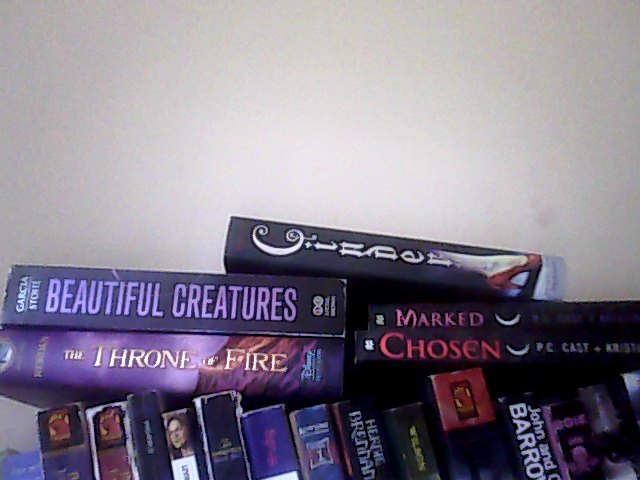
Q: Activity: Spine Poetry. Create a line of poetry with your book spines (take a picture). Not feeling creative? Tell us about your favorite poem.
My webcam isn't the best. And neither are my photography skills. So, here are the books and my line of poetry:
"Cinder:
Beautiful Creatures Marked,
The Throne of Fire Chosen."
[Cinder (Marissa Meyer), Beautiful Creatures (Garcia/Stohl), Marked and Chosen (Cast and Cast, The House of Night series), and The Throne of Fire (Riordan, the Kane Chronicles book 2).]
I don't really know what my own poem means, but it sounds really cool. It sounds like something out of Narnia. "People judged to be too beautiful are sent to the Throne of Fire, a sort of electrical chair except instead of killing you with electricity, it enlightens you and brings you to life by setting fire to you..." Or something like that. It sounds like an idea for a novel... Hmm...
(And, just because... Can you see the tops of the spines of the books below them? Can you guess which books they are? Okay, I'll tell you. In no particular order, there are Levine's Ella Enchanted, Rowling's Harry Potter and the Sorcerer's Stone, and Goodman's Eona.)
As for my favorite poem... William Blake's "The Tyger." No contest.
"Tyger! Tyger! Burning bright
In the forests of the night,
What immortal hand or eye
Could frame thy fearful symmetry?"
Symmetry is pronounced "sihm-ih-try". Gotta say something for poetic license.
There are a whole six stanzas in the poem; I'm too lazy to copy the whole thing, only what I know from memory, so feel free to look the rest of it up. In fact, here, I googled it for you.
How about you? What's your favorite poem? What does my poem mean to you? What sort of poem can you create with the spines of your books? Have a blessed Friday and weekend!
Friday, November 23, 2012
Follow Friday #25
[Happy Thanksgiving to those who celebrate, and happy Black Friday shopping! It's been a crazy couple days for me, so I apologize for the semi-lateness of this post.]
Follow Friday is a weekly meme hosted by Alison Can Read and Parajunkee.
Q: What blog are you thankful for? Are you thankful for a fellow blogger? Tell us about him/her.
Oh goodness. I'm thankful for so many blogs, I can't mention them all. One of the first blogs I ever looked at (almost, what, a year or so ago?) was The Epic, The Awesome, and the Random. Book/writing blog - Annie is awesome.
Um.. Querytracker is a writing blog that I get a LOT of tips from. My revision will be easier thanks to that blog. (I believe a multitude of bloggers participate on that blog.)
YA Stands, Birds Of A Writer, Down the Rabbit Hole, and Steph Bow's Hey! Teenager of the Year all help me look forward to the days occasionally. They have some unique voices/content/stuffs that make me smile. Or agree. Depending on the topic. (The first two and the last are writing blogs. Down the Rabbit Hole is an art blog, I believe, with fairy tales and other stuffs - including a Whovember right now.)
Now, don't get me wrong, I am thankful for every blog I coem across. I tend to read articles more than blogs, and I am thankful for every article I coem across, trust me. Knowledge for the sake of knowledge and all that. It's just that I am following 165 blogs right now, I don't have time to look at or name every single one, so I chose the random ones I read more often.
So, without further rambles or talks, I bid you good night. (That sounded really formal.) Have a blessed weekend, and remember to stay thankful!
Friday, August 31, 2012
On Unrelated Stuffs
So, this post is basically going to be a bunch of links elsewhere, to random but highly awesome places. Whether inspirational, wierd, or just plain interesting, I'm going to post them anyways.
Have you heard about this dad who wears skirts in support of his cross-dressing son?
Does writer's block exist? Before you spout this advice, think.
Posted earlier this month that I just can't stop thinking about, what is the relationship between dreaming and depression?
This article on how much your mind wanders while reading is worth reading.
Do you know how to write horizontally and vertically?
"Dead Genres" - should you write them if the trend has ended? This post talks about whether you should still write that paranormal romance if it might not sell.
I start school next Tuesday, so I have to make sure these next few days are relaxing and wonderful. As for y'all, have a blessed Friday and many hopeful smiles for your weekend!
Have you heard about this dad who wears skirts in support of his cross-dressing son?
Does writer's block exist? Before you spout this advice, think.
Posted earlier this month that I just can't stop thinking about, what is the relationship between dreaming and depression?
This article on how much your mind wanders while reading is worth reading.
Do you know how to write horizontally and vertically?
"Dead Genres" - should you write them if the trend has ended? This post talks about whether you should still write that paranormal romance if it might not sell.
I start school next Tuesday, so I have to make sure these next few days are relaxing and wonderful. As for y'all, have a blessed Friday and many hopeful smiles for your weekend!
Subscribe to:
Posts (Atom)