Showing posts with label Ambiguous Creativity. Show all posts

Friday, November 28, 2014

Thanksgiving. (Yesterday's Account.)

I am thankful for my family, (though we are reeling from loss).
I am thankful for my life, (though I am hurting).
I am thankful for the roof over my head, (though it's painful to be home).
I am thankful for my health, (though I've had a cold this week).
I am thankful for my books, (though I can't escape myself completely in them anymore).
I am thankful for my college, (though it is painful to be there, as well).
I am thankful for --
For --

I am thankful for my faith and belief in God and Jesus, (because without that, I would truly go mad.)

Angel (left), Tumble (right)

Wednesday, July 30, 2014

So, an Update Might Be in Order

In case you hadn't noticed, I changed the theme of my blog around. I liked the black and white and blue, but I needed a change.

Lately, I've been thinking more than usual. If you follow my blog, you might have noticed I've posted much less this summer than I have for most of the year. And mostly, I've been thinking over what I want from this blog. (And about cats.* But that's not unusual from me.)

This blog, evident from its name, is really about the Writer Me. The Reader Me. The part of me who'd spend the rest of her life in a library if she could. And yes, the change in its looks goes into that. I like the slightly more mellow look this has; it looks more relaxed and softer, somehow, and that's what the reader part of me looks like: a girl who likes books, and daydreams about being a fairy, and likes writing about her daydreams.

But I feel like I've begun to lose focus. A lot of what I post are book reviews and ranting against random book-ish topics. I started this blog for that, yes. But a large part of what I post is also personal updates, and why I have trouble following a regular schedule. The Writer Me is not my whole identity. But my "whole identity" isn't really a part of this blog. I didn't start this blog for it to be about my whole identity.

And so, henceforth, I plan on posting more book reviews and more book-related topics. Maybe there'll be the occasional gem dug up through the constant research I go through. But I feel uncomfortable just writing stream-of-consciousness here.

I realize the majority of you lovely readers are probably readers. Maybe you are writers, too. Maybe you review books. That's what we have in common: we love books. That's what this blog is about, sharing a love of books.

Now, that still leaves the matter of the rest of me. Like many writers, I have a life outside of my writing. (If I didn't, I would probably end up on the streets; writing doesn't exactly pay well when you haven't even been published yet.) And I want to talk about that, too.

After a lot of thought, I think I might start up another blog, one on the Student Me. The one that wants to go to college, and get good grades, and learn everything I want to know. (The writer part of me likes to conveniently forget homework and studying that I don't want to do.)

Since I am going off to college, I'll be pretty busy. And running two blogs won't help. So, instead of posting on Mondays, Wednesdays, and Fridays (and failing miserably), I'll likely post on one blog every Monday, and the other every Friday. With maybe the occasional Wednesday post. I'm thinking I'll post on here on Fridays, since the weekend is when I do most of my writing/reading/random research.

But I want to know what you think. Should I keep a separate blog for my more personal life? Or do you like my sporadic, stream-of-consciousness posts under my Life In General tag? Comment on this post or vote in my poll!

Have a blessed July day and enjoy these photo of my sister's kittens. :)


*Odin: his main talents are looking cute and knocking things over. Also, he's very good at being curious and taking his medicine.


Mary Shelley: fun-loving, adorable, and very jealous that she is no longer the center of attention. But I still love her.


Wednesday, April 16, 2014

Well, you know... Life.

I'm on spring break right now. Yea. Spring Break. Do you know how I've spent it? Watching TV, knitting, petting my cats. I finished the draft of my WIP, so I've put my writing down for this week -- make it truly a break. I haven't even really been reading; I've picked up and put down half a dozen novels since Saturday.

Sometimes I wish I could just-- I just wish I could get out of my house every now and then. I don't have a driver's license, but even if I did, there just isn't much to do around my neighborhood. This is the suburbs: a lot of residential homes, a convenience store within walking distance (though, without money, isn't exactly ideal); there's a Wal-Mart 20 minutes away, and a Food Lion maybe ten minutes from here, and a couple of libraries. Barnes and Noble and a movie theater are also twenty minutes up the road.

But still, I've been to the library this week. I have no money to go to any stores, or to a move theater. There aren't really "parks" around here, except one like half an hour away. And that's like a Lord of the Rings adventure, to go that far. We generally don't like spending a fortune in gas.

So instead, I sit here. I just watched three hours of Bones, on TNT. I ate a bag of popcorn. Colored in my coloring book. Knitted a little. Something heavy and sad sits in my rib cage, like a rock of emotion tying me to the couch. Which sounds a little melodramatic, but sometimes I might as well be tied to the couch. My cats come and sit on my chest, Siamese cats who'll compete to sit up on my shoulders and on my chest. (I think the ones who get stuck sitting in my lap and on my legs are further down the hierarchy. Because, yes, cats do have a social hierarchy -- probably a very strict one, considering how much they claw at each other.)

I've been considering college. And, like a lot of the rest of my life, I fear I'll have to settle for my second best. Actually, between the three I've been accepted to, there are two I'm considering with any enthusiasm. One is a co-ed college, the other an all-women's college. I'd like to go to the all-women's college. I'm planning on majoring in archaeology, which involves hard sciences like chemistry and earth science -- in an all-women's college, I could hope to avoid some of the -- well, men. I took chemistry last year, earth science my freshman year. Sometimes the guys get a lot of attention, even though the teachers -- female teachers -- do their best to get to us shy girls stuck at our little table near the middle of the room.

But of course, the women's college is more expensive. The enrollment is like, $500. The enrollment at the co-ed college is $300. And the co-ed college is close enough to my granddad's that I could live off-campus, cutting down on costs even more. No study abroad. No trips across the country after I graduate this June. At the co-ed, they offer a classics major, too -- that should offer less hard sciences, right? More art history? Perhaps I could take that.

Or, maybe, I could just not go to college at all. My sister and mother have incurred enough student debt without me adding to it. (Actually, I don't think we even qualify for loans.)

Maybe I could get a full-time temp job over the summer, at the factory where my dad works. I could spend twenty years working there, just like him, and marry and have kids and never have any money above a middle-middle class existence, just. Like. My. Family.

Is it so much to wonder, that maybe I want a little something more? To travel, even if it makes my stomach churn in anxiety? To... to be rich, one day, lots of money, and I wouldn't have to worry about whether or not I can afford to go to college, or sit around bored during Spring Break while other students get to go to other states, visit family, go on vacation?

I realize that I need more than a high school diploma to do anything. But a college degree is no guarantee, either, and I don't even really want to go. I am just getting out of the public school system. I don't want to go back into another educational system, one I can't actually afford, even with the rather hefty scholarships they're throwing my way, even if they offer me into their Honors program with smaller classes and more control over what classes I want to take.

If only I could... I don't know. Be free to sit in a library, in any library, and just read what I want to learn for myself. No sitting in hard science classes, where I may or may not get to actually do lab work, depending on what gender my lab partner is. (In an archaeology major, probably a guy. There aren't exactly many who decide to major in it, and I imagine quite a few of them are male, as a lot of science-y jobs are.)

But, of course, life will not fall at my feet and give me whatever I want. I could not go to college, and maybe end up like my brother -- working hard, all day, no flexibility in hours, and at the end of the year get nothing back in tax returns. I could go to college; perhaps I'll be like my mother, who's getting her master's degree in religion, who complains sometimes of male teachers who never give her more than, "It's alright," even when she's spent all day on a paper to perfect it and most of the other guys in her class slapped something together. Spend all day reading and annotating and writing essays, like that's all there is to life -- essays waxing eloquent about one topic or another, no flair allowed.

I know the essays we write in public school. College ones just seem to be longer and more unnecessarily complex. And I am sick of writing them.

But I can't just become a writer. I can't afford to sit around all day and daydream. But I can't stand working my entire life and getting nothing back, or wracking up so much debt I'll be paying it off the rest of my life, and maybe also get nothing in return.

Maybe one day I'll leave the United States, go to... I don't know. Ireland. Russia. Australia. Maybe, while I'm at it, I could grow a pair of wings and join a fairy cult. Because I can't really do what I want, become whoever I want to be, like those well-meaning adults in elementary school tell you. Sometimes, I really can't do anything at all, except sit on my couch. Now it's a marathon of Law and Order: Criminal Intent.


Wednesday, January 1, 2014

"Resolutions" I Might Actually Keep

It's the first day of 2014, guys. The ending of a year, the beginning of one. I suppose I should be happy for a clean slate this year, but we all know that in school, it's not "clean." I still have to do my projects from before break. (Namely, and AP Lit project on WW1 and a textbook assignment from AP Bio.)

But I don't want that to spoil my first few days, at least. And my last few days of break. And since I didn't finish reading the book I told myself I'd finish yesterday, I think I'll post some of my New Year's Resolutions.

(As a side note: why do they call them "resolutions?" You've resolved to do something, yes, but you rarely get around to them. So aren't they more under the category of, "Promises I Only Intended to Keep?")

Anyways. I hope to:
  1. Finish at least half of my TBR pile. (The whole pile is numbering close to fifty, now.) 
  2. Paint my room over. (It's my little sister's old room, and the most atrocious yellow color. Also, she left a few foul-mouthed messages written across them.)
  3. Get my driver's license. (I've only got my learner's permit right now.)
  4. Turn 18 years old in April. (That one should be easy to keep.)
  5. Graduate in June. (Also easy. I'm pretty much guaranteed it at this point, as long as I keep showing up to school.) 
  6. Work on my knitting. (As in, at least every week. Right now, it's looking pretty sad.)
  7. Work on clay. (Something I've always wanted to do, but now that I have clay and space to work with it, I find myself reluctant to start.)
  8. Put up some puzzles. (I have half a dozen of them sitting around my room.)

This seems like a rather paltry list, and doesn't even include my writing resolutions, but it towers over me with all the menace of Cerberus.* I'm not used to proactively doing things for myself. I read a book, I wait for someone to order me to do chores. Watch some documentaries on TV. I barely even do my homework for myself.

Which is why I've set the threshold so low. Some puzzles, working with clay, turning 18 years old. Though, really, these are all big milestones. At 18, I'm officially an adult. Officially Not a Child Anymore. And I have an entire lifetime in which I have to proactively do things for myself. So I've got to get a head start a few months beforehand.

This post seems rather serious to me, for a day we're all supposed to be celebrating. There are no exclamation points, no smilie faces. Just talk of my plans. I've never been good at humor or light-hearted material.

But I suppose that's what New Year's is about. The beginning of a year, and talk of what's going to be done. (Or what might be done.)

Have a blessed Wednesday, New Year's, and life, everyone.

*Cerberus the three-headed dog from the Underworld in Greek mythology. It's extra menacing because I'm not overly-fond of dogs, since we own an Australian Shepherd who barks at everyone but my mother.


Zazu says to keep to your resolutions.

Friday, November 1, 2013

Happy Dia de Los Muertos, and Happy Nanoing!

Hi! It's Friday, it's the First of November, and you know what that means. It's Nanowrimo. It's the Day of the Dead. And it happens to the start of what hopefully is a great month.

First off, Nanowrimo -- writing a novel in a month. Yes, I'm participating. (Q: What should I be doing write right now? A: Not writing blog posts!) My idea is weird, and involves rebellions, other worlds, and Mozart. It's titled "The Wolfgang" for right now. I might be referring to it obsessively over the next month, and shall usually abbreviate it to WG.

Now, yea, I haven't finished my other draft. I'm decently sure I can keep up 3k words a day -- 2,000 words for WG, and 1,000 for WR. ("Wretched Roads". Mages, healers, and curses, if you care to know.)

As for Dia de los Muertos... It's a Mexican holiday celebrated on November 1st and 2nd, honoring dead loved ones. I've written about it before, a couple weeks ago. So instead of a long rant on something that has little relevance, here's a list of Spanish words:
  • Calaveras -- skulls. Also, there are calaveras de azucar (accent on the u), which are sugar skulls. 
  • Calacas -- skeletons.  From what I know, these are very popular, like Halloween skeletons are popular: toy skeletons on the altars or for the children, cloth/plastic ones on poles that they parade through the street, etc.
  • Altar -- well, an altar. Not too hard to figure out. The table on which they set offerings of food, flowers, and photographs to the dead loved one.
  • Cempachusil (accent on u) -- marigolds. They put these "flor de los muertos" (flowers of the dead) on the graves or altars of loved ones. 
  • El pan de los muertos -- bread of the dead. Literally, bread they leave on the altar for their loved ones.
 

November is a grand, brown-ish, most-definitely-autumn month. It generally means cold, lack of sleep, picking up the academic pace, and writing a novel for me. But it's also full of colorful leaves, and days off from school for Thanksgiving, and snuggling under five or six different blankets without feeling stifling-hot.

So, here's to dead people, writing too much too fast, and a brown month full of leaves and cold. Who says a little cold is bad for you, after all? It clears your lungs from all those words that scratch at your ribcage, ready to crawl out.

Have a blessed Friday and weekend!

Friday, September 20, 2013

Photography, Colds, and Writing

Thank goodness it's Friday. Truly.

Do you know that annoying person who doesn't cover their mouth when they cough? And not just once or twice, accidentally; people who cough into the air of their room, go upstairs and cough in your living room, and in your kitchen, all over your food...

Yea, I'm talking about a member of my family. My youngest brother -- who just started 6th grade -- never covers his mouth when he coughs, and now the rest of the family has it. Mostly me at this point -- he's had it several days, then my mom and sister fell sick, and my dad, and now me, the girl whose time spent happily locked up in her room serves a useful purpose.

Except now I've been sneezing and my nose dripping; I've been covertly wiping liquid snot-stuff over the sleeves of my jacket all school day. (Yes, and I am one of those people who goes to school even when she's sick, and so gets everyone else sick. We all have our flaws.) My throat
feels like sand has gritted the inside of that tube that leads from your mouth to your lungs. My eyes are sore and sticky, and I haven't slept or showered since Wednesday. Or Tuesday. But I've finally caught up on most of the school stuff I needed doing.

Thankfully, in spite of the Cold from Dante's Inferno,* I have not had a terrible time. I made my first primitive photograph in photography class. Here's the process:

  • First, you have to expose a sheet of photo (light sensitive) paper to white light in the dark room. This means positioning it under a machine that looks sort of like a microscope, except it shines down light on the thing you're doing instead of observing it closely. And it means adjusting that machine to the right setting of intensity, making sure the light is focused, making sure the frame of light is big enough to cover the entire sheet of photo paper...
  • Exposing takes about five seconds. You position the photo paper beneath the enlarger (so the microscope-like machine is called), position the object whose image you want to make on top of it, and then you turn it on and white light floods the little area of paper. 
  • After that, you dip it in a chemical called Dektol (developer), a soapy-like, basic liquid. Basically, it makes the white photo paper turn black, except for the white shape of your object. You keep it there a minute to a minute and a half. 
  • The second chemical you dip it in is called Stop Bath. It's a yellow color, because when you transfer the paper from Tray A to Tray B, some Dektol inevitably ends up in the tray of Stop Bath. Stop Bath actually is an acid, so it neutralizes the Dektol. Eventually, as the effectiveness of the Stop Bath wears down, it turns a purple-y color, thereby alerting you to change the liquid. You keep it in this tray for 30 seconds. 
  • The THIRD chemical is a smelly (vinegar-like) liquid called fixer. It makes the image permanent. You dip it in there for 3-4 minutes. 
  • Finally, you get to rinse the residual chemicals off the paper by putting it in this large, round sink for ten minutes. The water spins around, so it can wash it properly. 
  • Then you squeegee it. You lay the paper on a piece of plexiglass, and use this rubber thing to scrape the excess water off both sides of the paper.
  • Next, there's what's called a print dryer. It's a machine in which you lay the paper on its flat surface, pull a stretch of worn, warm canvas over it, and lock it into place. You rub the canvas for a minute, unlock the canvas's metal-rimmed edge from the side of the machine, and turn your photograph over to the back side. Then you lock it into place and rub the canvas for another minute.
  • Found here, via Wiki/CC. This is what it's supposed to look like!
  • And voila! Your photograph is ready. As long as you didn't mess up on any stage of the process. 


So, yes, that's the entire process I went through, to end up with a black paper, no image. Apparently, I didn't expose the paper correctly, though my teacher assured me I did the chemical part correctly.

How was that for a story? Well, not really a story. More of an anecdote of how to make it through a class period when you barely know what you're doing. And, speaking of stories, the third draft of my story is turning out suck-ish, thank you for asking. I'm so sick and busy that when I do get a free moment to work on it, I find that I want to sleep instead of write, and nothing comes out onto the paper. (Metaphorically speaking, of course. I type my stories out on my laptop.)

But anyways, for those of you who didn't know, this is how you make a photograph without a camera! It's an interesting experience. Hopefully, I'll make an image next class. And also hopefully, by next class my nose won't be dripping into the water wash.

Hope you have a blessed Friday and weekend! Get better at the things you love, get over sicknesses, and get a proper amount of sleep!

*You know by Dante's Inferno I mean the h-word, right? The devil's homeplace? I just have a ton of trouble including even the mildest of inappropriate words, in both speech and in writing.

Wednesday, September 4, 2013

Photography

Second day of school. I'm left with a rather strange feeling: a content, almost blissful peace, not what you'd expect after eight hours of slouching in uncomfortable chairs until your neck hurts and your brain wishes to wash away the excess of words and instructions that you've semi-listened to all day.

Does that sentence make you think this is about a boy? Some nice guy who makes the slouching, invisible girl feel like the world? Well, it isn't. (And thank goodness for that. I'm such a fussy, perfectionist person that no one could live up to my standards. Sometimes I don't live up to them.)

No, what that sentence is about is photography, designing, literature, and creativity in general. Because, you see, last period on even days is Photo 1, or Photography for Beginners.

Photo 1, I figured out, sounds like the coolest class I could've signed up for. Because, this isn't digital-camera photography, where you can photoshop it; this is a class where I need an actual film camera. My teacher recommended one built in the '80s or '90s, because fun fact: cameras from that time were built of all metal components, making them more durable.

There is a dark room, with those big sinks and shallow containers for the chemicals to help develop the film, and where, when you're working, you keep all the lights off except for a single amber-colored light that barely illuminates. Even a special door, a cylinder with two openings -- one to go in, one to go out -- with an inner cylinder that allows you to switch between the two rooms without letting in any of the harmful flourescent light. (Flourescent light can ruin the film.)

Perhaps you might already know this "dark room." But I am a sheltered teenager, and this is an entirely new concept. The only thing I really know is the typical crowded classroom, my home and church and library; we rarely went on trips, back in elementary and middle schools, and I don't go out on my own. This dark room is an unexpected and curious break from my life.

Now, it's only the second day, of course. The teacher is going to have us begin at the beginning of photography -- making cameras out of oatmeal containers and tape -- and working up to the actual film camera, which we don't need to obtain until October. (This, by the way, is an AWESOME teaching technique, one that sadly is almost never used. To build the camera, to see how it works, BEFORE picking it up and applying it. If only they did that for say, math. Or government. To see where and how and why it works, and the history behind it? Providing context makes the concept pop.)

Educational rant aside, this class already seems epic. We even have field trips, come November. I haven't been on a field trip since... what, eighth grade? 2009-2010? Years of school where there are no break except for the occasional pep rally. *shudders* When I'm an adult, I should try and fix that. If I can. If I'm not some homeless, saddened, sick shell of a person.

I do apologize. I keep getting off topic. What I mean to say is, creativity comes in many forms, and I've discovered one today: photography. It's a lot more complicated than I thought it would be, but like writing, I find that I don't dread it; I look forward to learning and growing in the study.

Now, if only every other academic and creative study were posed in a way that makes me look forward to the next class.

Have a blessed day!

Wednesday, August 14, 2013

On Genres: Romance vs. Contemporary

Last Monday, I wrote on Fantasy and Paranormal.

Last Friday, I wrote on Sci-Fi and Dystopian.

Today, I want to write more on romance and general fiction.

Have you ever noticed how prominent romance is? (Yes, I've written about it before.) Yes, it's most definitely a genre, but it's also a subgenre... of almost every other genre. Fantasy, sci-fi, contemporary/general, historical... name it, you can add romance to it. I think because it doesn't require any specific setting or elements, other than the relationship itself.

Now, of course, this is where genre becomes subjective. Is it a romance with paranormal elements? Or a paranormal with romantic elements? It's really your decision, but what if it counteracts the author's opinion on the genre? Does that mean you are wrong?

One of the most beautiful things about books is that everyone takes something different from it. That's why I can detest Twilight, love Harry Potter, and change my mind about The Hobbit.

Which is what I want to talk about, really. Changing your mind.

Last summer, I picked up The Hobbit and the Lord of the Rings, and read both in about 2-3 weeks. And I detested it, especially the endings. (Frodo, how dare you leave Sam behind! He went to freakin' Mordor with you! Did you care about how he must be feeling, seeing you on the lip of Mt. Doom?!)

But now I have an English summer project, and I decided to re-read The Hobbit, because I'm suspicious of Dorian Gray. (It's an AP Lit class, so I have to choose a fiction book! Yay!) And now I'm thinking... you know, it's not as hard to read as I remember. The description is still a bit much, but it's still a good story, and the adventure is certainly attention-catching. In fact, instead of just worldbuilding epic fantasy, it's a true adventure-fantasy.
 
And so now, I'm kind of liking The Hobbit. Of course, I haven't gotten to the ending, which I detested most of all. But I can manage a project on it without screaming. And that, I hope, is because I've grown since the first time I've read it: I've read bad and good and mediocre books in the year.

My point: you've read good, bad, mediocre books yourself. And you probably have read different books than me -- sure, there'll be some overlap, but you haven't read the exact same books for an entire year. And even if you did, you'd get something different out of them than I, a teenage girl who leaves her house pretty much only for school and the library, gets out of them.

And that means your opinion on the genre of a certain book can be different, as well. And that your opinion of the genre (and how much you enjoy it!) can change over re-readings.

[NOTE: Romance is a very changeable, depending on the age group. And, of course, I'd hope that it only just barely exists in MG, in a fairy-tale fashion, since eleven-year-olds exploring love/sex is rather atrocious. But still, I'm trying not to bias these to any one age group, though since I read YA it's sort of biased towards that.]

[Also note: "contemporary" means the same as "general" or "realistic" in my eyes. This is mostly because I'm lazy, and if it's not historical, it's present-day/modern enough to classed as something like contemporary.]

CONTEMPORARY:
def. -- set in the modern world (as in, after about the 1980s), and can be about a wide variety of "real-world" issues, such as eating disorders, anger/abuse problems, or mental health.
often seen -- conflicts with police/family/creditors; mental issues, like struggling with depression; settings in New York or London; today's technology, or even brand names like Coca Cola; etc.
common plots -- as mentioned, struggling against an internal problem or a financial problem. Often, romance involved and struggling with, as well.
Examples: Hate List by Jennifer Brown, Speak by Laurie Halse Anderson, Imaginary Girls by Nova Ren Suma
(Note: these are all YA titles. I don't read much adult, and most of the MG I read is in the fantasy genre.)

Some Contemporary Sub Genres:
  • One of the most popular is contemporary romance, combining both of these.
  • Contemporary/Urban Fantasy, when magical elements are set here (such as Percy Jackson).
  • Contemporary Paranormal, when vampires are living in the seedy underworld of a city, for example. 

ROMANCE:
def. -- a story that revolves around the relationship between two people, which can be set anywhere or combined with many, many diverse elements.
often seen -- a "strong" or "kick-butt"* girl falling for a boy; a geek falling for a cheerleader, or poor falling for a rich, or any such combination; a boy falling for a girl.
common plots -- same as above; love triangles, too.
Examples: I try not to read much overt romance. But you can find romance pretty in any book you pick up, if not as the main plot then as an element.

Some Romance Sub Genres:
  • Contemporary romance, as mentioned above.
  • Paranormal romance, very popular in YA (apparently).
  • LGBTQ novels -- in which the MCs are gay, transgender, or the like. Surprisingly, I don't mind this little niche of romance as much as the rest of it. And, like romance, it can range wide into other genres -- see Eon by Alison Goodman, for example.

Yea, I recommend reading my rant on romance (third link up there, near the top of this post). Romance is kind of overwhelming, very popular, and ever prevalent, possibly because it does range over literally any other genre.

How about you? What do you think about genre and romance? Can you list any of your favorite contemporary or romance?

Have a blessed Wednesday!


*When I say "kick-butt", you know what I really mean, right? I'm incapable of even mild swearing, because I set myself to my own standards. And, of course, there's the whole "My protagonist is strong NOT" aspect, in which the character is really kind of flimsy. Which is a very, very common occurrence, especially to female protagonists.

Friday, August 9, 2013

On Genre: Dystopian vs. Sci-Fi

Monday, I wrote on what I feel is the exact difference between fantasy and paranormal.

Today, I want to go into more detail, and outline two more genres: dystopian and sci-fi.

Genre has always seemed like a strict rule, with clear boundaries: there is this, and there is that. But with more and more hybrid books and sub-genres out there, genre strikes me as less a strict rule and more an ambiguous identity, where the boundary between two genres is one thing to one person and something completely different to another.

What does that mean? What effect does that have on literature? You already see the influence: think of books labeled wrong. I once read a book I thought was strictly paranormal... until I realized it was romance, with paranormal elements. But the summary didn't mention any romance -- the central element -- at all! (needless to say, I was a bit ticked off.)

The beauty of it, though, is that you draw the line. Usually, I think the author's right, or the publisher or the bookstore/library, in deciding genre. It's a lot easier to walk through a library and let a book catch your eye when it's labelled with that purple unicorn that means fantasy, or the two hearts that mean romance. Because, well they've read the book.

And after YOU'VE read it, you can sort that book into what you think its genre is, in your little mental library.
 
(Did anyone else automatically think of Sherlock's "mind palace" when they read that? Ooh, a "mind library" where you store all the books you've ever read and sort them into the genres you think they are.)

[Anyways. Back to my genres -- as a disclaimer, I say again: this has little to nothing to do with AGE GROUPS. I realize there can be some elements or tropes different between YA and, say, MG, within the same genre. And I read mostly YA, so my opinions are decidedly biased toward YA, but I do think, overall, it applies to all age groups.]

SCIENCE FICTION: 
def. -- type of fiction that often focuses on technology, with a sub-focus on society or worlds. A different world, but little to no magic or supernatural elements like in fantasy. A lot like dystopian, but less focused on the negative aspects and it's a lot older as a genre. 
often seen -- new types of weapons (light sabers, etc); new types of conveniences or luxuries; the kick-butt hero whose sides are dripping with weapons; future or otherworldly settings
common plots -- saving the world, high-action-y sort. (I admit, I don't read as much sci-fi. Sorry.)
Examples: Star Wars, War of the Worlds, (Doctor Who? It's a bit hazy, with the paranormal elements)

Some Science-Fiction Sub Genres:
  • Sci-fi/fantasy, where those two genres mix. (Decently common, especially in YA.)
  • Steampunk, where history and science fiction meet! (That sounded like an ad.)
  • Dystopian/sci-fi, where there's a balance in focus on government and technology. 
   
DYSTOPIAN:
def. -- type of fiction that focuses on government and society, typically set in the future. Specifically, it focuses on the negatives or downsides of a certain government/society, with a sub-focus on the downsides of technology.
often seen -- war, death, brainwashing; set in the future of an already existing society (ex: America); struggling, world-weary, rebellious characters
common plots -- overthrowing a government; saving the world; struggling to remain a human in inhumane societal conditions.
Examples: The Hunger Games, numerous YA novels or novels from the 20th c. looking forward (ex: Animal  Farm/1984, two of Orwell's novels)

Some Dystopian Sub Genres:
  • Sci-fi/dystopian, because these two are pretty interwoven.
  • Dystopian fantasy, in which fantasy elements -- such as magic or otherworldly settings -- are included.
  • Dystopian romance, in which characters struggle to maintain a relationship in a strict or inhumane societal condition.  

These two genres, to me, are very interrelated and the boundary's even more ambiguous than others. I think the pulse here is that dystopian highlights the negative aspects of a way of being, while sci-fi will focus more on technology and futuristic society and is less... how do I say it... negative-oriented. Dystopian is a warning for the future; sci-fi is action that happens to be set in futuristic elements.

How about you? Where do you draw the line between these two? And what do you think on the boundaries between genres?

Have a blessed Friday!


Monday, August 5, 2013

On Genres: Fantasy vs. Paranormal

I think I have it somewhere in my archives (what a lovely word!), but I decided that I'll do an entire post on Genre Stuffs.

Because, you see, "genre" can be subjective. How often have I walked into B&N and seen evidence of this? Sci-fi and fantasy mixed together, paranormal and fantasy mixed together, historical and general mixed together.

The problem, really, comes in with the sub-genres. Paranormal romance; urban fantasy; historical romance. Remember, this is all my own conjecture, but I tend to think that it's deciding the "main" genre where things get subjective. Is this more historical, or more romance? Is it more fantasy, or more general fiction (or magical realism, even)?

Where do the genres and sub-genres collide? Is steampunk its own genre, or a mix of historical and sci-fi? Is paranormal romance a genre, or just accepted as one?

So, I decided to post my ideas of the (fictional) genres and sub-genres, based on what popular culture actually gets through my head. MY ideas of where those boundaries lie. Because, ya know, it's really important. To maek sure this post doesn't stretch to kingdom come, this will be the first of a series.

[REMINDER: I am not going to specify YA and Adult and MG into their own "genres", because they're not. They are age groups. Elements outside the characters -- say, typical settings or tropes -- can be the same in the same genre, even when they're part of different age groups.]

FANTASY:
def. -- a type of fiction in which characters (minor or major) are non-human, and have never been human. Magic is typically prevalent.
often seen -- elves, dragons, wizards/warlocks/witches; kingdoms, monarchy; Wise Old Mentor characters and Epic Medieval-Type settings.
common plots -- destroying or finding a magical artifact; an Epic Journey; a need to overthrow somebody (usually the King).
Examples: Eragon, Lord of the Rings, Circle of Magic (Tamora Pierce)

Some Fantasy Sub-Genres: 
  • urban fantasy, where modern-world settings collide with some of the often seen.
  • fantasy romance, where romance features heavily, perhaps even being the main plot.
  • Sci-Fi/Fantasy, where the book actually does blend elements of the two.  


PARANORMAL:
def. -- a type of fiction in which characters (minor or major) are non-human, but were human at some point.
Otherworldly or superhuman powers typically prevalent, less often magic.
often seen -- ghosts, zombies, vampires; a city or "haunted" building setting; the Kick-But Hero/ine with a bad attitude.
common plots -- relationships between humans and non-humans; defeating/exorcising an Evil Non-Human Entity; surviving a war/attack between the two.
Examples: most ghost stories (local haunts), some myths (Hades and the Underworld); The Mortal Instruments (I believe; I've never read the series, so I couldn't say definitively).

Some Paranormal Sub-Genres:
  • Paranormal Romance, the biggest one nowadays; romance between a non-human (usually a vampire) and a human. (Typically a human girl and male vampire, thanks to Twilight.)
  • Paranormal Horror/Dystopian, which features conflict between the two; such as a zombie apocolypse.
  • Fantasy Paranormal, where the two genres mix: think the pain-removed soldiers in Galbatorix's army (I can't remember which Eragon book, all of a sudden. And sorry if that's a spoiler.)

Paranormal, I think, is where you see sub-genre the most. It gets mixed with romance very often -- especially in YA -- or you see elements of paranormal mixed into something like general fiction (I generally think Miss Peregrine's Home for Peculiar Children).

So, that is my definitions of these two. Next week -- or possibly this week, since I only now realize it's book-review Monday -- I'll discuss Science Fiction and Dystopian.

How about you? Do you have differing views of the boundary between these two? Know any more common plots or often-seen, or think of any more sub-genres? Let me know in the comments!

Have a blessed Monday! 


Friday, July 5, 2013

Sweetgrass Basket by Marlene Carvell

In prose poetry and alternating voices, award-winning author Marlene Carvell weaves a heartbreakingly beautiful story based on the real-life experiences of Native American children.

Mattie and Sarah are two Mohawk sisters sent to an off-reservation school after the death of their mother. Subject to intimidation and corporal punishment, with little hope of contact with their father, the girls are taught menial tasks to prepare them for life as domestics. How Mattie and Sarah protect their culture, memories of their family life, and their love for each other under this forced assimilation makes for a powerful, unforgettable historical novel.

~Print copy (library), 243 pages
Published: 2005 by Dutton Children's Books

This book... definitely worth a read.

At first, I thought this would be a bit plot-slow, that this would be a fast read. But the characters are rather engaging -- Mattie, the rebellious elder sister, looking after her little sister Sarah, who in turn wanted to keep her older sister out of trouble; Ruthie and Gracie, their friends who might be more fearful but try to be loyal nonetheless; and, of course, the evil villain, Mrs. Dwyer, who runs the school.

It's set in a special school during the early 1900s (late 1890s?), meant for Native Americans to learn English and "White People" culture. Of course, this was before things like making girls work in a boiling hot laundry room all day was frowned upon. Mrs. Dwyer, the headmistress (or whatever her title is; I'm not really an expert on school titles from over a century ago) has the girls march every place, makes sure Mattie and Sarah -- who've never been apart -- don't have beds next to each other's, and when they don't follow rules, has them skip supper. At one point, Mattie writes a beautiful short story about her mother's basket weaving, and when the English teacher tries to have it published in their school newspaper, Mrs. Dwyer has it crushed for being too "Native American".

There is, of course, a plot, though it drags a bit in the first half of the novel. It's written quite beautifully, though, between the two sisters. The plot really picks up about halfway through, when the abuse suffered at the hands of Mrs. Dwyer gets worse, due to her thinking that rebellious little Mattie stole a brooch of hers.

The verse format makes this an easy read, but not a "dumb" or "inferior" read. It's just as complicated and real as a real novel. It's written almost directly how the characters think, and not along traditional styles of worldbuilding and scene-setting. It's more sparse, like poetry that insinuates the scenery in fewer words.

I also like the incorporation of Native American words into the novel, words like "Father" and "Mother" that really makes the whole family theme stick out without pushing it in your face. And how Carvell adds details of home, of their culture, into the current scene; things like a basket taken from home, how they remember the river outside their home, short myth stories (or really, summaries of those stories). It really makes this book stand out as not some "boring historical" but as a deep, cross-cultural novel.

Overall, this novel was pretty heart-rending. I didn't like the ending, though I appreciated the inevitability of it -- not that I'll spoil it for you. But it has a genuine, beautiful feel to it, and I recommend that everyone read it. Four stars.


Friday, June 14, 2013

Follow Friday #49


[Meep! School is over! Summer vacation!! ;D]

Follow Friday is a weekly meme hosted by Alison Can Read and Parajunkee.

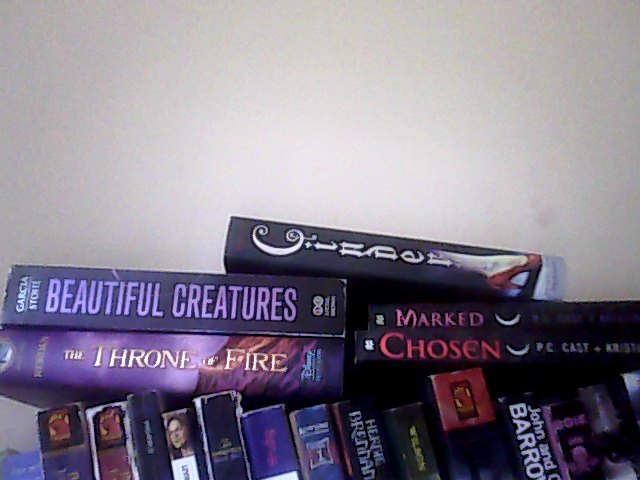
Q: Activity: Spine Poetry. Create a line of poetry with your book spines (take a picture). Not feeling creative? Tell us about your favorite poem.


My webcam isn't the best. And neither are my photography skills. So, here are the books and my line of poetry:

"Cinder:
Beautiful Creatures Marked,
The Throne of Fire Chosen."

[Cinder (Marissa Meyer), Beautiful Creatures (Garcia/Stohl), Marked and Chosen (Cast and Cast, The House of Night series), and The Throne of Fire (Riordan, the Kane Chronicles book 2).]

I don't really know what my own poem means, but it sounds really cool. It sounds like something out of Narnia. "People judged to be too beautiful are sent to the Throne of Fire, a sort of electrical chair except instead of killing you with electricity, it enlightens you and brings you to life by setting fire to you..." Or something like that. It sounds like an idea for a novel... Hmm...

(And, just because... Can you see the tops of the spines of the books below them? Can you guess which books they are? Okay, I'll tell you. In no particular order, there are Levine's Ella Enchanted, Rowling's Harry Potter and the Sorcerer's Stone, and Goodman's Eona.)

As for my favorite poem... William Blake's "The Tyger." No contest.

"Tyger! Tyger! Burning bright
In the forests of the night,
What immortal hand or eye
Could frame thy fearful symmetry?"

Symmetry is pronounced "sihm-ih-try". Gotta say something for poetic license.

There are a whole six stanzas in the poem; I'm too lazy to copy the whole thing, only what I know from memory, so feel free to look the rest of it up. In fact, here, I googled it for you.

How about you? What's your favorite poem? What does my poem mean to you? What sort of poem can you create with the spines of your books? Have a blessed Friday and weekend!